


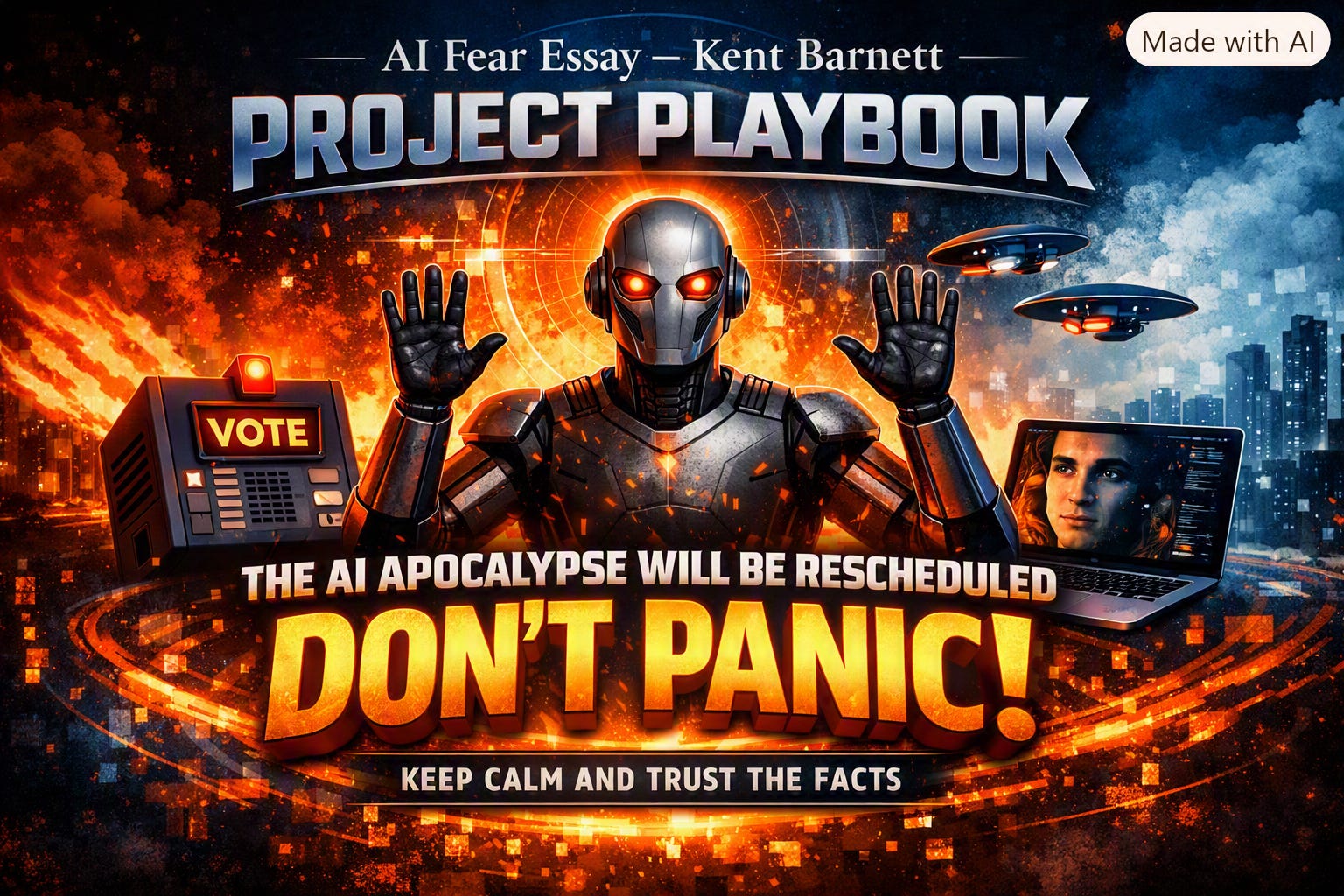
Why the robots aren’t becoming conscious, why quantum computing won’t summon Skynet, and why the real threat is fear itself.
Let’s get something out of the way: Every week, someone online declares that artificial intelligence is about to become conscious, overthrow humanity, and possibly steal your Netflix password. The headlines scream. The influencers panic. The politicians fundraise. And somewhere, a YouTuber is filming a thumbnail with their mouth open like they’ve just seen the face of God in a GPU rack.
Meanwhile, the actual AI systems are over here confidently hallucinating that the capital of France is “baguette.”
So let’s take a breath.
Because the fear is loud, but the facts are boring -- and that’s exactly why we need to talk about them.
1. The Consciousness Question: Are the Robots Waking Up? Short answer: no. Long answer: still no, but with more syllables, (like this) NNNNNNnnnnnnnnOOOOOOooooooo!
AI today is a very fancy autocomplete machine. It doesn’t “want,” “feel,” or “experience.” It doesn’t wake up in the morning and wonder about its purpose. It doesn’t stare out the window contemplating the meaning of existence. It doesn’t even have a window.
When people say “AI is becoming self-aware,” what they usually mean is: “AI said something spooky and I forgot it was trained on the entire internet, including Reddit.”
If AI ever did become conscious -- and we’re talking science-fiction levels of hypothetical here -- then yes, humans would be its gods. We wrote the code. We built the hardware. We created the training data. We are the cosmic parents of the machine world.
But today’s AI? It’s not conscious. It’s not close. And if it ever does get close, it will probably ask us why we spent so much time arguing online.
2. Quantum Computing: The Plot Twist Everyone Loves to Fear Quantum computing is the boogeyman of tech Twitter. People talk about it like it’s a magical portal that will instantly turn AI into a sentient demigod capable of rewriting reality.
In truth, quantum computing is still in its awkward teenage years -- brilliant, promising, and occasionally unable to get through a math problem without falling over.
Will quantum breakthroughs make AI faster? Yes. Will they make AI conscious? No. Will they break encryption someday? Possibly -- which is why cybersecurity experts are already working on quantum-safe cryptography.
Quantum computing is not the fuse that lights the AI apocalypse. It’s more like the espresso shot that makes AI do what it already does... just faster.
3. The Election Panic: AI Is Coming for Your Ballot (Apparently) Now we get to the fun part: politics.
Every election cycle, someone claims AI can “change votes in voting machines.” This is usually accompanied by a blurry TikTok video, ominous music, and a person whispering like they’re leaking classified intel from a bunker.
Here’s the reality:
· Voting machines are not magically hackable by chatbots.
· Election systems have layers of security, audits, and paper trails.
· Most misinformation online is still created by humans, not AI.
· Deepfakes exist, but “cheap fakes” -- simple edits, misleading captions -- are far more common.
AI can amplify misinformation. AI can generate fake content. AI can confuse people who already distrust the system.
But AI cannot reach into a voting machine and flip your vote like it’s changing the channel.
The fear is politically useful, though. It’s a great way to rally supporters, raise money, and blame a mysterious digital force for everything that goes wrong.
Fear is a political asset. AI is just the newest costume.
4. So Why the Panic? Because fear is profitable.
Fear gets clicks. Fear gets votes. Fear gets attention. Fear gets regulation passed faster than facts ever will.
AI is the perfect villain:
· It’s invisible.
· It’s complicated.
· It’s everywhere.
· And nobody agrees on what it actually is.
If you’re trying to influence public opinion, AI fear is a Swiss Army knife. You can use it to warn about foreign interference, corporate greed, government overreach, or technological collapse. It fits any narrative you need.
But that doesn’t make the narrative true.
5. The Case for AI: Why We Actually Need This Stuff Here’s the part nobody puts in the headlines:
AI is becoming essential.
Not optional. Not experimental. Essential.
We need AI to:
· Detect misinformation faster than humans can scroll.
· Strengthen cybersecurity as quantum threats grow.
· Accelerate scientific research.
· Manage the complexity of modern systems.
· Compete globally with nations who are not slowing down.
AI is not the threat. Fear is the threat. Fear slows innovation. Fear cedes leadership. Fear creates bad policy. Fear makes people believe voting machines are possessed by digital demons.
We don’t need less AI. We need better AI, responsible AI, and public understanding that isn’t shaped by panic merchants.
6. So Where Do We Begin? Right here.
This Substack series can do what the headlines won’t: Explain the reality. Defuse the fear. Show the stakes. And remind people that technology is not destiny -- it’s a tool.
A powerful one. A necessary one. And one we should shape with clarity, not hysteria.
If AI ever becomes conscious, we’ll cross that bridge when the robots start writing poetry about their feelings. Until then, let’s focus on what’s real, what’s useful, and what’s worth building.