


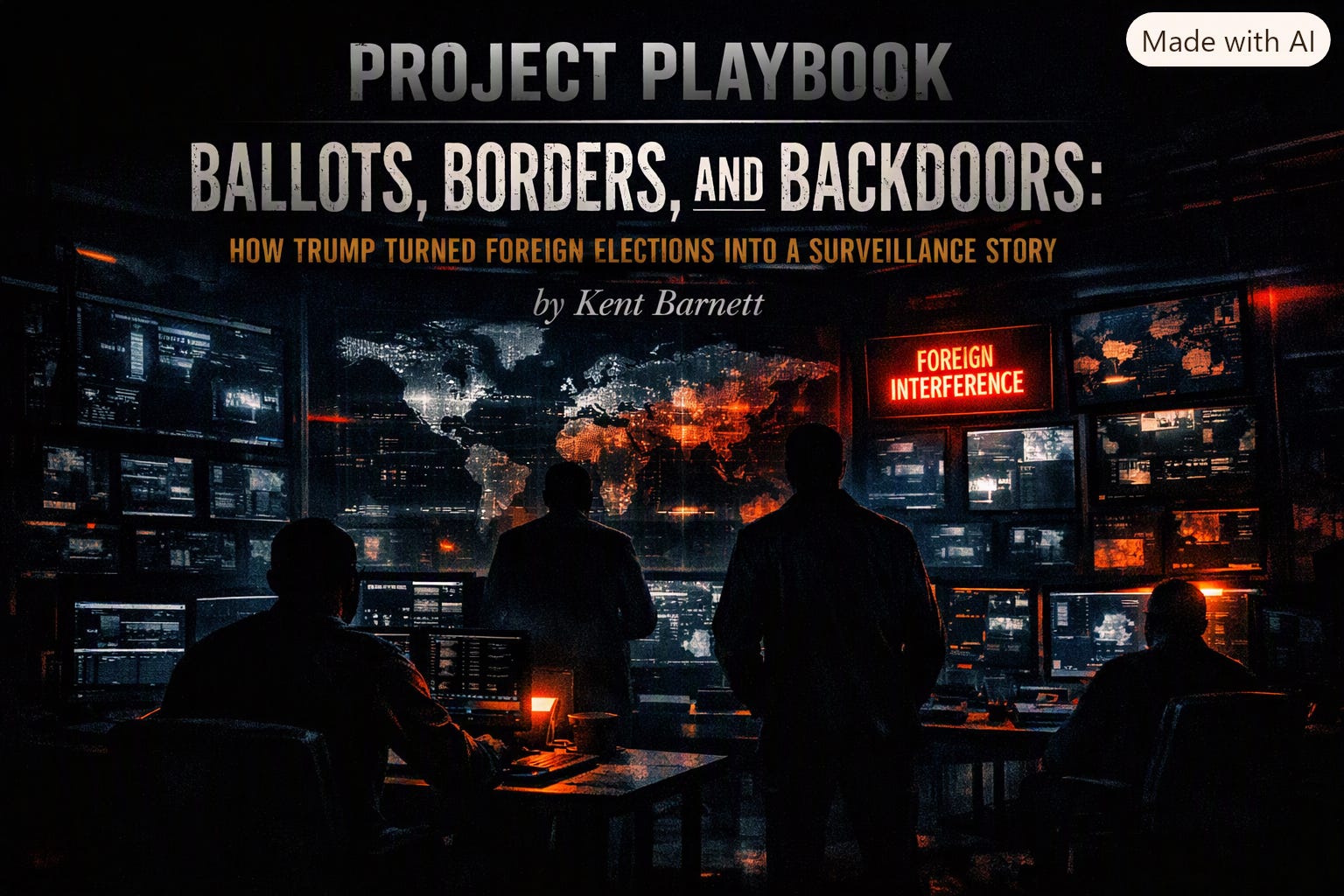
The smoke always points somewhere.
In Washington, when someone needs you looking left, the real action is happening on the right — in a budget markup at midnight, in the language of a reauthorization bill nobody read, in the slow institutional hemorrhage of an agency stripped to its bones before anyone noticed the bleeding had started.
This is that story.
I. The Setup
Every well-run operation needs a villain the audience can see.
Russia worked elegantly for years. China is more useful now — bigger, more diffuse, harder to argue with. Iran when the narrative needs texture. The foreign threat is real. Make no mistake about that. But in the hands of a shrewd operator, real threats are also useful ones. Fear is a budget line. It is a rationale. It is a door left open while everyone is watching the window.
In the midterm cycle now underway, the Trump administration has raised the volume on foreign election interference to a primetime pitch — a live televised address, a push for sweeping voter regulation, a cascade of warnings about China, Russia, and Iran targeting American democracy. The rhetoric is genuine in tone. The intelligence, less so.
The New Yorker documented in August 2026 that the White House has been distorting intelligence assessments on foreign interference rather than acting on them — inflating threats that serve the political narrative, suppressing or ignoring findings that complicate it. The Foreign Malign Influence Center at ODNI, the very office built to track and brief on these threats, has been scaled back, its staff cut as part of a broader purge that eliminated more than 500 ODNI positions — roughly 30 percent of the agency’s workforce — by August 2025. The New Yorker+1The New Yorker. Why Donald Trump Talks So Much About Foreign Election Interference | The New YorkerBrennan Center for Justice. Trump Administration Cuts Make Elections More Vulnerable to Foreign Influence and Disinformation | Brennan Center for Justice
The administration is, in other words, simultaneously warning of a foreign threat it has made itself structurally incapable of detecting. That is not incompetence. That is architecture.
II. The Dismantling
Let’s account for the bodies.
CISA — the Cybersecurity and Infrastructure Security Agency — is the primary federal firewall between your ballot and a foreign adversary’s intrusion capability. When Trump returned to office in January 2025, CISA had approximately 3,300 employees. By December 2025, that number had fallen to roughly 2,400 — a loss of nearly 900 people. DOGE terminated contracts and fired staff in waves that eliminated CISA’s entire red team, more than 80 employees working on continuous monitoring, and between 30 and 50 incident response staff. A federal judge ordered reinstatement; reinstated staff were placed on paid administrative leave — returned in name, absent in function. TNWTNW. Trump’s FY27 budget would cut $700M from CISA and kill election security
The Trump administration’s FY2027 budget proposal goes further: a $707 million cut to CISA and the complete elimination of its election security program — 860 more positions gone. If enacted, CISA would operate on roughly $2 billion, less than two-thirds of what the Biden administration requested for the agency in 2025. TNWTNW. Trump’s FY27 budget would cut $700M from CISA and kill election security
The FBI’s Foreign Influence Task Force — created during Trump’s first administration in direct response to Russia’s 2016 operation — was disbanded by Attorney General Pam Bondi on February 5, 2025, her first day in office. Bondi said it would “free resources” and reduce “politicized enforcement.” The task force was charged with investigating covert foreign influence activity targeting U.S. elections. CBS NewsCBS News. Trump zeroes in on election security. His team has cut thousands of election-focused federal workers. - CBS News
The State Department’s Global Engagement Center — the interagency hub coordinating responses to Russian, Chinese, and Iranian propaganda — was closed. The ODNI’s Foreign Malign Influence Center was scaled back. Staffers monitoring foreign disinformation campaigns in elections were among those jettisoned. Brennan Center for JusticeBrennan Center for Justice. Trump Administration Cuts Make Elections More Vulnerable to Foreign Influence and Disinformation | Brennan Center for Justice
The Justice Department’s Civil Rights Division saw senior career attorneys responsible for voting-rights enforcement reassigned, and the DOJ withdrew from multiple voting-rights cases. CBS NewsCBS News. Trump zeroes in on election security. His team has cut thousands of election-focused federal workers. - CBS News
Every institution with the mandate and expertise to detect and counter foreign threats to American elections has been cut, defunded, disbanded, or placed in administrative limbo. The midterms are months away. Iran, China, and Russia — all with documented, ongoing influence operations — are watching a defensive wall being demolished in real time. Brennan Center for JusticeBrennan Center for Justice. Trump Administration Cuts Make Elections More Vulnerable to Foreign Influence and Disinformation | Brennan Center for Justice
III. The Backdoor Architecture
While the outward defense was being torn down, the inward apparatus was being fortified.
Section 702 of the Foreign Intelligence Surveillance Act was enacted in 2008 as a counterterrorism instrument — a way to surveil foreign terrorists abroad without the friction of individualized court orders. The catch, baked into the statute’s architecture from the start, is that when the NSA collects the communications of foreign targets abroad, it inevitably collects the communications of every American those targets ever contacted. Those communications — your emails, your calls, your texts — sit in a government database. And under 702, the FBI can query that database using an American’s name as the search term. Without a warrant.
They are called “backdoor searches” because that is exactly what they are. Brennan Center for JusticeBrennan Center for Justice. Section 702 of the Foreign Intelligence Surveillance Act, Explained | Brennan Center for Justice
Congress reauthorized 702 in April 2024 through the Reforming Intelligence and Securing America Act (RISAA) — with nominal new safeguards: agents must record reasons for backdoor searches, obtain supervisory approval, submit to DOJ audits. The FISA Court’s March 2025 opinion revealed that the FBI had been systematically violating every one of these requirements from the moment the law passed. The bureau was operating a covert “filtering” tool that allowed it to query Section 702 data off the books — not counted, not tracked, not audited. The CIA and NSA are reportedly running similar tools. The numbers reported to Congress are incomplete. The abuses going through those tools are going undetected and unreported. Brennan Center for JusticeBrennan Center for Justice. FISA Section 702: New FISA Court Opinion Reveals Continuing Violations by FBI
The 702 authority is now up for reauthorization again — expiring June 12, 2026 under the new timeline. President Trump is encouraging Congress to renew it. Reform advocates have spent months pushing for a warrant requirement before the FBI can search Americans’ communications in the database. The “watered-down warrant proposal” circulating in Congress in April 2026, per the Brennan Center, is “the worst of both worlds” — creating the appearance of a guardrail while leaving the backdoor open. Brennan Center for JusticeBrennan Center for Justice. Section 702 of the Foreign Intelligence Surveillance Act (FISA): 2026 Resource Page | Brennan Center for Justice
The pattern is not subtle: the authorities that watch inward are expanded, extended, and protected. The agencies that watch outward — at the foreign actors seeking to undermine elections — are cut, closed, and eliminated.
IV. The Inversion
There is a word for what happens when you dismantle the agencies watching foreign threats and simultaneously expand the apparatus watching domestic ones.
In the summer and fall of 2025, Homeland Security Investigations — previously focused on transnational crimes like human trafficking, fentanyl smuggling, and money laundering — was redeployed to conduct election fraud investigations across multiple states. HSI agents sought voter records in Ohio counties. A White House-linked lobbyist contacted county clerks in Colorado; a caller identifying as a CISA official sought access to Dominion voting machines. Federal law enforcement raided Fulton County, Georgia for 2020 election records. The DOJ demanded Wayne County, Michigan turn over 2024 election records. ReutersReuters. How Trump is moving to control U.S. elections, one state at a time | Reuters
The resources pulled for this effort came from somewhere. “What are they pulling resources away from?” a 20-year HSI supervisory veteran told Reuters. “An investigation of a child being exploited? Fentanyl being smuggled?” ReutersReuters. How Trump is moving to control U.S. elections, one state at a time | Reuters
This is the complete inversion of the stated mission. The foreign threat is cited to justify the domestic action. The domestic action redirects the resources that would detect the foreign threat. The loop closes, neatly, on the American voter.
V. The Stakes
This is not abstract, and it is not distant.
The midterm elections are months away. China and Russia targeted congressional races with disinformation in 2024. They are not taking this year off. They are probing systems that, a year ago, had defenders. The defenders are gone. Brennan Center for JusticeBrennan Center for Justice. Trump Administration Cuts Make Elections More Vulnerable to Foreign Influence and Disinformation | Brennan Center for Justice
The Section 702 database — with its uncounted, unaudited backdoor queries by FBI agents who have previously used it to search the communications of Black Lives Matter protesters, members of Congress, a congressional chief of staff, a state court judge, journalists, political commentators, and 19,000 donors to a single congressional campaign — approaches another reauthorization deadline with no meaningful reform in sight. Brennan Center for Justice+1Brennan Center for Justice. Section 702 of the Foreign Intelligence Surveillance Act, Explained | Brennan Center for JusticeBrennan Center for Justice. FISA Section 702: New FISA Court Opinion Reveals Continuing Violations by FBI
And the officials now prosecuting election integrity investigations across a dozen states are drawing on an agency — HSI — that had no election security mandate eighteen months ago, staffed with agents reassigned from transnational crime units, conducting inquiries that a former supervisory agent described as having no statutory nexus. ReutersReuters. How Trump is moving to control U.S. elections, one state at a time | Reuters
What the administration calls election security looks, from inside the architecture, like something else entirely.
VI. The Close
Every investigation has a moment where the evidence stops being circumstantial and starts being structural.
The agencies dismantled are the ones that watched foreign threats. The authorities expanded are the ones watching you. The findings that might explain the discrepancy have been classified, withheld, or never produced. The officials responsible for both the dismantling and the expansion are, in most cases, the same people.
The New Yorker put it plainly in August: after Trump’s partisan primetime speech on foreign interference, if his administration tried to warn voters about a genuine, well-executed covert influence operation, would anyone believe it? And every foreign adversary — Russia, China, Iran — has sought, above all else, to sow doubt about American democracy. The New YorkerThe New Yorker. Why Donald Trump Talks So Much About Foreign Election Interference | The New Yorker
In that, they have a collaborator in the architecture being built around them.
Ballots. Borders. Backdoors.
The question was never whether the foreign threat was real.
The question is always: who benefits from your fear of it, and who decides what you’re allowed to know?
ENDNOTES:
1. Goudsward, A., Landay, J., Banco, E., & Cooke, K. (2026, July 17). Five things to know about Trump’s election fraud allegations. Reuters.
2. Center for Foreign Interference Research. (2026). Election Interference Reports (Brazil, United States, China, Iran, Russia).
3. Baines, P., & Jones, N. (2018). Influence and Interference in Foreign Elections. Journal of Political Marketing.
4. Schia, N., & Gjesvik, L. (2020). Hacking Democracy: Managing Influence Campaigns and Disinformation in the Digital Age. Norwegian Institute of International Affairs.
5. The Conversation. (2026, October 2). Beyond hacking: How foreign governments can exploit vulnerabilities to manipulate elections.
6. Brazilian Intelligence Agency (ABIN). (2026). Assessment on potential U.S. interference in the 2026 Brazilian elections.
7. U.S. Senate Correspondence to Secretary of State Marco Rubio. (2026). Letter urging non‑interference in Brazil’s 2026 elections.
8. CIA. (2004–2020). Summary of intelligence reporting on Venezuelan electronic voting manipulation capabilities.
9. U.S. Intelligence Community. (2021). Assessment of China’s 2020 election influence considerations.
10. House Foreign Affairs Committee. (2026). Inquiry into foreign influence operations targeting U.S. political systems.
Project Playbook© tracks how corporations, governments, and media networks use power, narrative, and institutional architecture to shape what the public sees — and what it doesn’t. Verified. Unsponsored. Unflinching.
© 2026 Kent Barnett. All rights reserved