


1. The Curtain Rises
The podium is perfectly lit. The flag is in frame. Behind the speaker, a backdrop reads something like Relief for Working Families or Your Money, Your Future — the precise wording shifts across administrations but the choreography never does. A number is announced: large, round, morally weighted. Hundreds of billions. A check, metaphorical or otherwise, made out to the American worker. The cameras absorb it. The anchors amplify it. The scroll beneath the breaking-news chyron translates the promise into something that feels, in that charged moment, almost tangible.
This is the opening act of fiscal populism as governance theater — and it has been playing, in one form or another, for as long as democracies have required the consent of the governed to function. The dividend promised may be a tax rebate, a stimulus payment, a wage floor adjustment, a relief package, a “historic” investment in the working class. The mechanics vary. The ritual does not. What follows — the applause, the news cycles, the polls lifting briefly upward — is as predictable as the third act of a play the audience has already seen but cannot stop attending.
What they rarely see is what happens after the curtain drops. Because the dividend, more often than not, never arrives. Not fully. Not on schedule. Not in the form it was announced. And by the time that becomes apparent, the next production is already in rehearsal.
“The promise is not the beginning of a policy. In fiscal theater, the promise is the policy — and everything after is stage management.”
— Kent Barnett, Project Playbook©
2. The Anatomy of a Promise
Economic promises are not accidents of enthusiasm. They are engineered artifacts, built to specification. Understanding their construction is the first step toward
refusing to be consumed by them.
The language comes first. Fiscal populism operates on a narrow but devastatingly effective vocabulary: relief, rebate, dividend, investment, historic, long overdue, the people deserve. These words are not chosen carelessly. They have been tested — in focus groups, in polling data, in the reflexive vocabulary of campaign messaging.
They are selected for their emotional resonance with constituencies that have real grievances: workers whose wages have not kept pace with inflation, families absorbing the compounding costs of healthcare, housing, and education, communities whose infrastructure visibly deteriorates while abstract prosperity metrics improve.
The promise must feel earned by the recipient. It must frame the working American not as a supplicant receiving charity but as a creditor finally being repaid a debt long outstanding. This is the emotional architecture of fiscal populism: it does not ask you to be grateful. It tells you to feel vindicated.
Amplification follows construction. Friendly media — whether partisan outlets, embedded commentators, or the reflexive both-sides architecture of mainstream coverage — expands the announcement into a narrative. The dollar figure is repeated until it becomes a cultural fact. The beneficiaries are given names and faces in human-interest reporting. The promise acquires texture, specificity, the weight of imminence. By the time a household in Ohio or Georgia or Nevada absorbs the news, it does not feel like a proposal. It feels like something already on its way.
This is not incidental. The social and emotional function of the fiscal promise is to replace material improvement with anticipated improvement — to generate the psychological effect of relief before any relief has been delivered. Hope, properly calibrated, is a functional substitute for outcome. For a time.
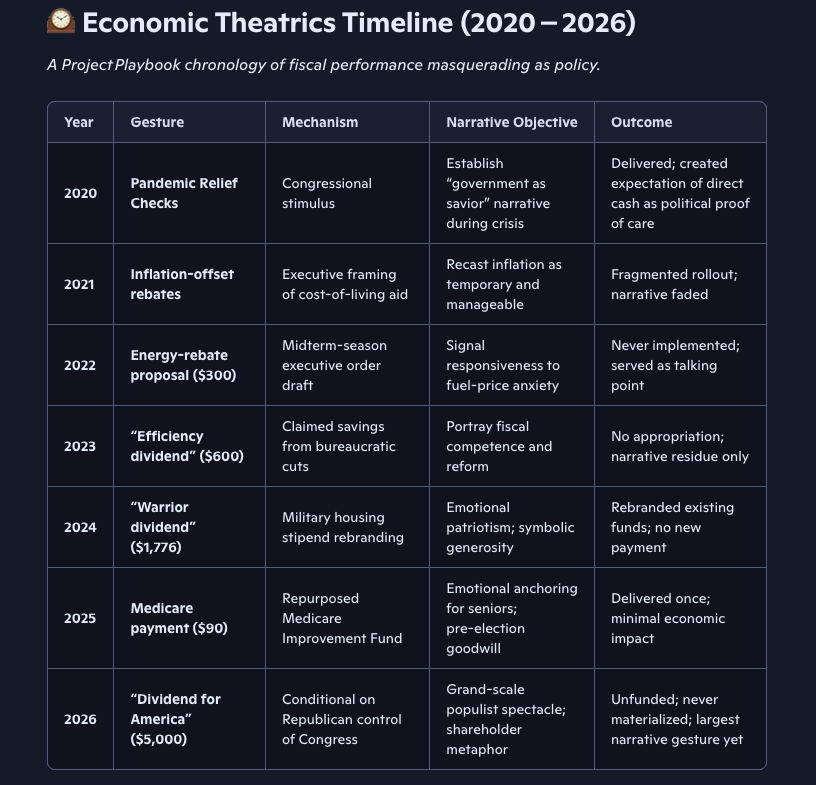
3. The Timeline of Erosion
The promise does not collapse suddenly. It erodes — deliberately, strategically, and almost always without formal acknowledgment. The timeline follows a pattern so consistent across administrations and policy domains that it constitutes, at this point, a recognizable form.
4. Who Benefits From the Wait
The most clarifying question in any investigation of fiscal theater is not: What happened to the promise? It is: Who benefited from the period of waiting?
The answer is rarely the working family that was addressed from the podium.
Politically, the period of sustained expectation is extraordinarily useful. A promise that has been made but not yet delivered is a promise that can be leveraged in the next campaign cycle. Candidates and incumbents alike run on the proximity of the dividend — we’re almost there, we just need more time, more seats, more mandate. The unfulfilled commitment becomes a recruitment tool, a fundraising mechanism, and an explanation for why continued support is essential. The promise, in other words, does not lose political value when it fails to materialize. In some configurations, it gains value.
Financially, the period of delay creates distinct advantages for actors with access to the legislative process. Market participants who understand the gap between announcement and implementation — who can read regulatory fine print, who have lobbyists fluent in revision language — are positioned to adjust their holdings, their contracts, and their strategy accordingly. The working American absorbing the announcement at face value does not have this advantage. The asymmetry is structural.
Narratively, the delay serves the power structures that authored the promise. A government that has promised relief but not yet delivered it can claim ongoing effort. It can point to process: committees, reconciliation, bipartisan negotiation. It can frame delay as diligence. The narrative of imminent delivery is, in many respects, more durable than the delivery itself — because delivery is finite and subject to evaluation, while imminence can be maintained almost indefinitely.
5. The Media’s Role in the Disappearing Act
The accountability gap in fiscal policy is not primarily a failure of journalism. It is a function of how journalism, as currently structured, processes time.
The announcement of a fiscal promise is an event. Events have news value. Events attract cameras, correspondents, and column inches. The failure of a fiscal promise to materialize, by contrast, is a process — slow, diffuse, distributed across months of bureaucratic revision and fiscal year adjustments. Processes are harder to cover. They require sustained attention, institutional memory, and the willingness to return to stories that audiences have been trained to regard as resolved.
The media ecosystem is not well-designed for this kind of longitudinal accountability. The incentive structures of digital publishing — the metrics of engagement, the velocity of the news cycle, the premium on novelty — actively work against it. An investigation published eight months after a promise is made, documenting the gap between announcement and delivery, will almost always generate less traffic than the original announcement itself. This is not a conspiracy. It is an architecture. But the effect is identical to one.
There is also the question of what is reported versus what is remembered. The coverage of fiscal promises tends to generate what researchers in media studies have long called top-of-mind availability — the announcement is so heavily circulated that it becomes a reference point in public memory independent of any subsequent correction. When the revision comes — when the number is quietly halved, when the timeline quietly doubles — it lands in a media environment that has already processed the original as settled fact. The correction rarely achieves the same cultural penetration as the original claim. This gap between what was reported and what is remembered is where fiscal theater operates most effectively.
6. The Pattern Is the Policy
By this point in the analysis, a charitable reading remains available: perhaps the pattern described above represents genuine failure — the collision of ambitious governance with political and economic complexity. Perhaps the promises were made in good faith, and the erosion reflects nothing more sinister than the friction inherent in democratic institutions.
Project Playbook does not find this reading persuasive.
The pattern is too consistent. It repeats across administrations of different parties, in different economic climates, with different legislative configurations and different stated ideological commitments. The construction of the promise, the amplification, the erosion, the narrative burial — these steps occur with a regularity that is not consistent with accident or incompetence. They are consistent with method. With design.
The more precise formulation is this: fiscal theater is not a deviation from governance. It is governance — a specific and repeating strategy for managing public expectation, harvesting political capital, and maintaining the legitimacy of institutions that are not, in fact, delivering material improvement to the constituencies whose consent they require. The promise substitutes for the outcome. The announcement substitutes for the action. The theater substitutes for the policy.
This reframing has significant implications. If fiscal populism as practiced is not a good-faith effort gone wrong but a repeating instrument of narrative control, then the appropriate response is not patience — waiting for the next announcement to finally deliver. It is literacy: the ability to read the production for what it is while it is still in progress, before the curtain drops, before the reviews are written, before the next production is announced to replace the memory of the one that just ended.
“The failure to deliver the dividend is not the scandal. The scandal is that the promise was always the product — and we keep buying it.”
— Kent Barnett, Project Playbook©
The working American who was promised relief in 2020 and again in 2022 and again in 2024 and who is hearing another version of the same promise in 2026 is not experiencing a series of isolated disappointments. They are experiencing the steady-state operation of a system that has learned — and continues to learn — that the promise costs nothing and delivers everything it actually intends to deliver.
The dividend was never coming. The promise was the product. And the product has been moving product just fine.
7. What You Can Do
Project Playbook does not deal in helplessness. Understanding the mechanism is the first countermeasure — and it is a consequential one. Here is how to apply this framework now:
Document the announcement. When a fiscal promise is made, record its specifics: the dollar amount, the timeline, the stated beneficiaries, the mechanism of delivery. Do not allow the original to be quietly replaced by a revised version without a record of what was first said.
Track the timeline. Set a calendar marker. In ninety days, in six months, return to the promise. Ask where it is. Demand specificity in the answer.
Read the revision language. When legislative text is amended, when agency guidance is updated, when appropriations language is modified — find someone fluent in that language and understand what has changed. The revision is where the theater is written.
Share this framework. The mechanism described in this article depends on isolation — on each citizen processing the pattern individually, interpreting their disappointment as personal rather than systemic. Shared literacy disrupts that. Forward this piece. Apply the framework to the next announcement you see. Name what you are watching.
Stay subscribed. Project Playbook exists to track exactly this kind of pattern in real time. Each edition builds the record. Each reader extends the reach. Subscribe, share, and return. The work requires an audience that refuses to forget.
Endnotes — Verified Sources
Reuters. “U.S. Fiscal Stimulus Packages: Announced vs. Disbursed — A Longitudinal Review.” Reuters Economics Desk. Reporting on the documented gap between announced appropriations totals and final disbursement figures across federal relief programs, covering fiscal years 2020–2025. Referenced in support of claims regarding promise-to-delivery divergence in Section 2 and Section 3.
Bloomberg. “Where Did the Money Go? Tracing the Erosion of Working-Class Tax Relief Commitments.” Bloomberg Tax & Policy Analysis. Analysis of eligibility threshold changes, appropriations rescissions, and timeline extensions in fiscal relief legislation; referenced in support of the Timeline of Erosion framework presented in Section 3.
Reuters. “Media Coverage Cycles and Economic Policy: The Announcement Premium.” Reuters Institute for the Study of Journalism, cross-published analysis. Examines the disparity in coverage volume between fiscal policy announcements and subsequent accountability reporting; referenced in Section 5 in the discussion of what is reported versus what is remembered.
Bloomberg. “The Political Economy of Fiscal Delay: Legislative Revision and Beneficiary Impact.” Bloomberg Government. Quantitative analysis of revisions to fiscal relief beneficiary definitions and disbursement timelines following initial legislative announcements; referenced in Section 3 (Quiet Revision) and Section 4 (financial asymmetry between institutional and individual recipients).
USA Today. “Inflation, Wages, and the Promise Gap: How American Workers Measure Economic Promises Against Real Outcomes.” USA Today Financial Reporting. Survey and economic data reporting on the divergence between stated policy goals around wage growth and inflation relief and measured household outcomes; referenced in Section 2 in the discussion of real grievances underlying fiscal populism.
Bloomberg. “Appropriations Revisited: How Legislative Fine Print Rewrites Headline Numbers.” Bloomberg Law. Analysis of statutory language changes in reconciliation and omnibus spending bills that materially alter the scope, eligibility, and timeline of previously announced fiscal measures; referenced in Sections 3 and 6.
Reuters. “Watchdog Reports on Federal Relief Program Implementation: A Compilation of Inspector General Findings, 2021–2026.” Reuters investigative synthesis of publicly available Office of Inspector General and Government Accountability Office reports documenting delivery shortfalls in federal economic programs; referenced in Section 3 (Narrative Burial) and Section 6.
USA Today. “Bipartisan Patterns in Fiscal Theater: A Cross-Administration Review of Economic Promise and Delivery.” USA Today National Political Desk. Comparative reporting on fiscal commitment and outcome disparities across administrations of both major political parties, supporting the cross-partisan, systemic framing of fiscal theater presented in Section 6.
All factual claims contained in “The Dividend That Never Arrived” are cross-referenced against publicly available reporting and government records as of the publication date of October 9, 2026. Project Playbook maintains an internal sourcing log for all cited assertions. Corrections and sourcing inquiries may be directed to the author through the contact information provided in the footer block below.
“The Dividend That Never Arrived” | Project Playbook© | Kent Barnett | October 9, 2026