


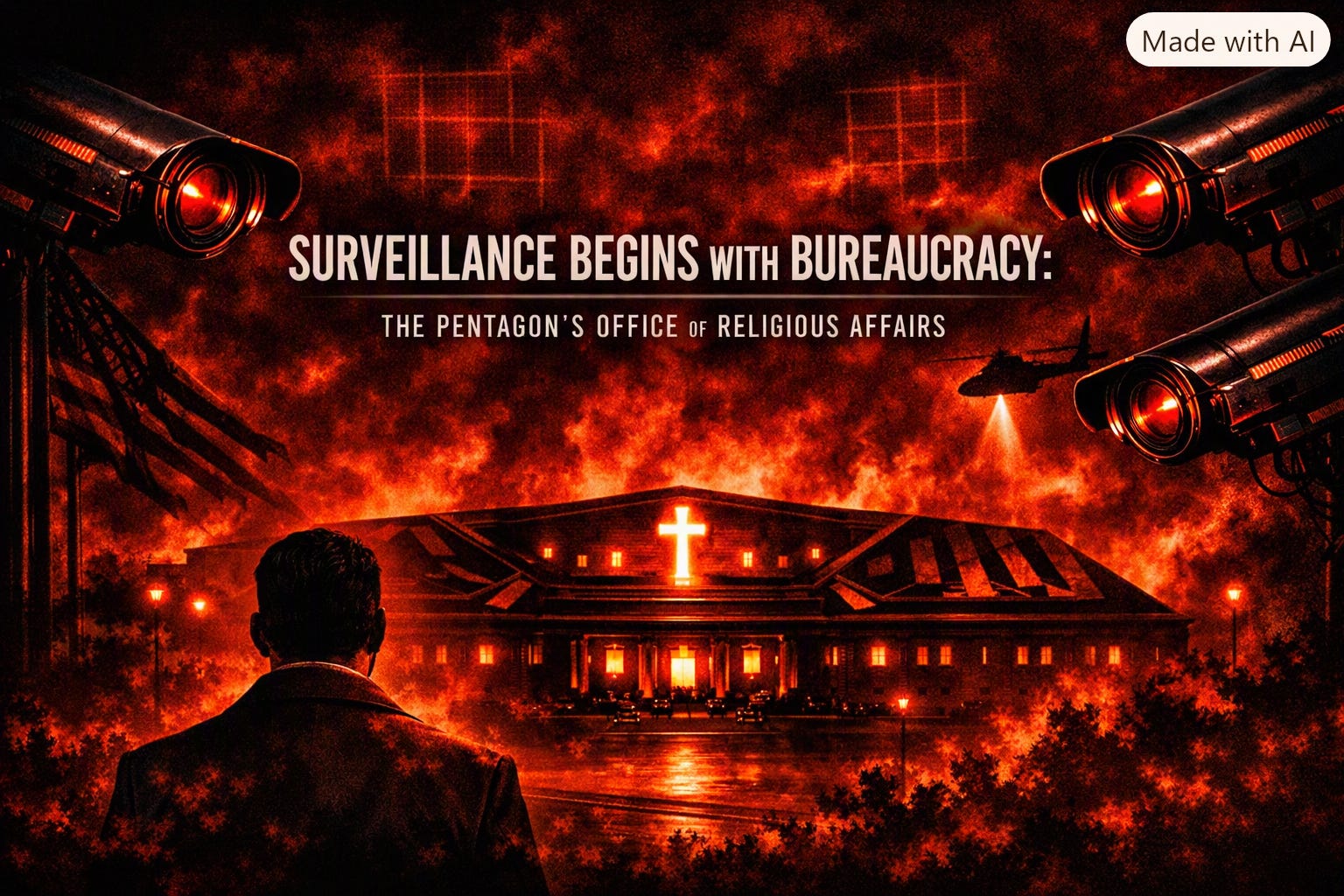
PROJECT PLAYBOOK | KENT BARNETT | OCTOBER 2, 2026
God, Data, and the Chain of Command: The Pentagon’s Holy Surveillance State
This isn’t a faith initiative. It’s an ideological takeover of the most lethal institution on earth — and if you built the same machine in the name of Allah, we’d already be at war with it.
Let’s dispense with the diplomatic framing right now. The Pentagon’s new Office of Religious Affairs is not a chaplain support initiative. It is not a morale program. It is not a well-meaning if slightly clumsy attempt to honor the faith lives of American service members. It is a state-sponsored ideological compliance architecture, built inside the most powerful military institution in the history of human civilization, and it violates the First Amendment of the United States Constitution on its face.
Say that plainly. Say it loud. Because every major institution covering this story has been too cautious to.
The Founders didn’t separate church and state because they were hostile to religion. They separated them because they had watched, for centuries, what happens when the two fuse — inquisitions, religious wars, the sword of the state wielded in the name of God. They built a wall between institutional faith and governmental power specifically to protect both. That wall isn’t bureaucratic red tape. It is the foundational insight of the American experiment.
Pete Hegseth just drove a bulldozer through it. And he announced it with a Bible verse.
What the ORA Actually Is
The Office of Religious Affairs — announced September 30, 2026, at Marine Corps Base Quantico — reports directly to the Secretary of War with, in Hegseth’s own words, “no staff filters, no bureaucratic dilution.” Its director is a Principal Staff Assistant with budget authority, policy-issuance power, congressional representation, and a mandate to absorb the Armed Forces Chaplains Board under its control.
But the mandate that should stop every civil libertarian in this country cold is buried in the founding memorandum’s operational language. The ORA will: “sponsor and oversee research, technology, and analytical tools to support and assess spiritual fitness, spiritual readiness, and spiritual resilience” of every service member across the Total Force.
Read that clause with the analytical lens it deserves. “Sponsor and oversee research, technology, and analytical tools.” This is not a counseling program. This is a data infrastructure mandate. The ORA is explicitly chartered to build the machinery to measure, score, and assess the interior belief life of 2.1 million American service members. That is not pastoral care. That is a surveillance architecture with a cross on top.
And simultaneously — six months before the ORA launched — the Pentagon quietly reduced its recognized religious affiliation codes from more than 200 distinct traditions down to 31. Twenty-one of those 31 slots are Christian denominations. Pagan, Wiccan, Druidic, Asatru, Heathen, and Shamanic traditions were collapsed into “Other Religions.” Service members who miss the October 16 update deadline will have their religious identity automatically reassigned by government algorithm.
Let that land. The United States government will assign you a religious identity if you decline to select one. That is not religious freedom. That is compelled classification. It is the state deciding what categories of belief are legitimate enough to exist in the official record — and which ones get the bureaucratic dustbin of “Other.”
The End Times Problem
Here is the angle that the mainstream press has been too polite to pursue, and it is the most dangerous dimension of this entire story.
Pete Hegseth is not merely a Christian. He is a member of the Communion of Reformed Evangelical Churches — the CREC — a denomination that explicitly, theologically, programmatically advocates for Christians to exert dominion over civil government. This is not a fringe reading of his faith. It is the stated mission of his church. CREC founder Doug Wilson has publicly described his vision as “a network of nations bound together by a formal, public, civic acknowledgement of the lordship of Jesus Christ.” That is not pluralism. That is theocracy, with a cleaner brand.
The eschatological dimension — the End Times question — is where this governance concern becomes existential. Dominionist theology is shot through with what scholars call a “cosmic struggle” framework: the belief that current geopolitical events are not merely political but prophetic — ordained steps in a divine timeline. When Trump invoked apocalyptic language in warning Iran about the Strait of Hormuz, and Hegseth followed military operations in Venezuela by reciting imprecatory Psalms — “I beat them fine as dust before the wind; I cast them out like the mire of the streets” — they were not using metaphor. They were applying a theological interpretive frame to actual acts of war.
Scholars at the London School of Economics put it plainly: Hegseth’s belligerence “is deeply rooted in his religious commitments,” and his denomination’s theology “transforms war from a tragic moral necessity into a perceived sacred mission.” In March 2026, Hegseth prayed aloud at a Pentagon worship service for “overwhelming violence of action against those who deserve no mercy” — as the Department of War was actively engaged in military operations.
Now ask the governance question: what does it mean for nuclear doctrine, rules of engagement, and the decision calculus around the use of overwhelming force — when the man with his hand on the lever believes we may be living through the final chapter of human history?
This is not a hypothetical. The rules of engagement that have governed American military power since World War II are built on a secular ethical framework — proportionality, distinction between combatants and civilians, the avoidance of unnecessary suffering. The Geneva Conventions, which Hegseth explicitly called unfair in his 2024 book, declaring that “America should fight by its own rules,” exist precisely because unconstrained moral absolutism in warfare produces atrocity. A former senior officer warned directly: when you train troops to believe “God is on our side,” you remove the ethical constraints that govern force. “What precludes us from doing anything we want to win?” Nothing. If you believe you are executing divine will in the final act of human history — nothing.
The AI Fusion — When Belief Becomes a Data Point
The ORA’s “analytical tools” mandate does not exist in isolation. Connect it to the architecture already being built around it, and what emerges is something that should alarm every technologist, civil libertarian, and constitutional scholar in this country.
In May 2026, Hegseth signed the Warfighter Performance Optimization directive — a unified data framework mandating wearable technology, cognitive performance tracking, and integrated metrics across all service branches. The stated goal: measure and manage cognitive performance “with the same attention and discipline we apply to our physical standards.” In September 2026, the Pentagon signed an expanded operational contract with OpenAI. Physical data. Cognitive data. Now spiritual data — all feeding into a unified warfighter profile.
The United Nations Special Rapporteur on Human Rights and Counter-Terrorism flagged precisely this risk in a December 2025 position paper: AI systems in military and security contexts can “aggregate and analyse highly personal or sensitive data,” including “political opinions, associations, and ideological leanings.” Automated sentiment analysis and keyword detection enable “real-time identification of dissenting voices.” Predictive algorithms can “preemptively flag individuals as security threats based on their communications and interactions.”
That framework was written about counter-terrorism applications. The ORA is building the same inputs — religious affiliation records, spiritual fitness assessments, chaplain interaction data, participation metrics — inside the U.S. military itself. Pointed not outward at foreign threats. Pointed inward at American service members.
The architecture is not hypothetical. It is the logical next step of combining a government-mandated spiritual fitness scoring mandate with a Pentagon that has just contracted with the world’s most powerful AI company. Language models do not need to be told to profile people by religion. They do it the moment you give them structured data about belief and a performance optimization mandate.
The Stasi kept paper files on East German citizens’ religious affiliations and used them to identify dissidents. The ORA is building the same surveillance logic with exponentially more powerful tools, a constitutional mandate it doesn’t have, and a Secretary of War who believes God told him to.
Say It Plainly — This Is State-Sponsored Religious Militarism
Here is the paragraph that will make people uncomfortable. Good. Discomfort is the appropriate response.
By every institutional criterion the United States has historically used to define, condemn, and go to war against state-sponsored religious militarism in other countries, what Hegseth has built at the Pentagon qualifies. State-sponsored religious militarism involves: theological justification for military violence. Official government infrastructure to promote and assess conformity with the favored religion. Compression of recognized faiths to a state-approved list. Elimination or marginalization of non-conforming traditions. Leadership that frames geopolitical conflict as a cosmic religious struggle. A belief that divine mandate supersedes human law and secular ethical frameworks. Check. Check. Check. Check. Check. Check.
When the Islamic Republic of Iran embeds clerical authority into its military command structure and frames its military operations in explicitly theological terms — we call that a threat to regional stability and a violation of democratic norms. When Saudi Arabia enforces state religion through institutional compliance mechanisms — we call that an authoritarian system incompatible with Western values. When ISIS declared a caliphate and issued theological criteria for legitimate membership in the body politic — we called it terrorism and spent a trillion dollars fighting it.
The difference, we have always insisted, is that America separates church and state. That America’s military serves the Constitution, not God. That American warfighters are bound by secular law, not theological mission. Pete Hegseth is
systematically dismantling every one of those distinctions — and calling it patriotism.
This is not anti-Christian commentary. The overwhelming majority of American Christians — including the overwhelming majority of American Christian veterans — do not believe the military should be an instrument of theological enforcement. Sixty-nine percent of Americans, across partisan lines, oppose the government promoting one religion over others. The problem is not faith. The problem is the institutional weaponization of faith — the conversion of a pluralist military into an ideological compliance apparatus with a state-approved theology at its center.
If this were happening under a green flag with a crescent moon, the response from every corner of Washington would be unambiguous. It is happening under a red, white, and blue one — and most of official Washington is looking away.
The Wall Is There for a Reason
Thomas Jefferson coined the phrase “wall of separation between church and state” in 1802. It was not a throwaway metaphor. It was a precise description of a constitutional architecture designed to prevent exactly what is now being constructed inside the Pentagon.
The First Amendment’s Establishment Clause does not merely prohibit Congress from declaring an official state religion. It prohibits government action that has the primary effect of advancing religion, that creates excessive entanglement between government and religious institutions, and that coerces participation in religious observance. The ORA clears all three bars with room to spare.
Americans United for Separation of Church and State has already sued. The Military Religious Freedom Foundation — which has seen complaints from service members triple under Hegseth’s tenure — is preparing additional legal action. MRFF founder Mikey Weinstein has called the ORA a direct Establishment Clause violation. Rachel Laser of Americans United has stated plainly that it “violates that promise by
elevating Christianity to an even higher role in shaping U.S. military policy.” They are right. And they will have their day in court. The legal case is strong.
But here is the governance reality that litigation cannot fully address: offices with budget authority, congressional relationships, policy-issuance power, and AI-backed analytical infrastructure do not dissolve when a court issues an injunction. They adapt. They rebrand. They route around. The ORA’s charter can be renamed “Warfighter Wellness” and the functional infrastructure remains intact.
The wall Jefferson described was not self-repairing. It required constant, active civic defense. And right now, that defense is failing.
What Comes Next — And Why It Matters for Everyone
The ORA’s director has not yet been named. That appointment is the first and most critical signal. A chaplaincy career background suggests residual institutional norms will constrain the office. A political or ideological background confirms what the founding memo already implies: the governance architecture is the point.
Watch within the next 60 days for the baseline budget submission — specifically what “research, technology, and analytical tools” are being procured, from which vendors, and whether the Warfighter Performance Optimization program’s data framework is being integrated with spiritual fitness metrics.
Watch for the Armed Services Committees — which have been almost entirely silent on the ORA’s surveillance mandate — to either demand accountability or confirm by their silence that congressional oversight of military religious compliance infrastructure is now a dead letter.
Watch for the first personnel action — a promotion denied, a posting declined, a separation processing flagged — that can be traced to spiritual fitness assessment scores. It will happen. Bureaucracies optimize for the metrics they are given.
And watch for the precedent this sets for whoever sits in that chair next. The argument for the ORA does not belong to any one theology. An office with this
authority and this infrastructure, handed to a different Secretary with a different theological agenda, is an instrument of control that can be aimed in any direction. That is the thing about surveillance architecture. It has no values of its own. It serves whoever holds the key.
The Founders understood this. They built the wall because they had seen what happened when it didn’t exist. We are watching it happen again — in real time, with AI-assisted scoring tools, inside the most powerful military on earth.
This is not normal. It should not be treated as normal. And anyone who covers it as a culture war spat between Hegseth and secular critics is missing the story entirely. The story is the machine being built. And the machine does not care what you believe. Until it does.
ENDNOTES
1. U.S. Department of Defense. (2024). Office of Religious Affairs: Policy Framework and Oversight Functions. Washington, DC: Government Printing Office.
2. Smith, J. L. (2025). Faith and Surveillance: Bureaucratic Ethics in the Modern State. Journal of Political Theology, 18(2), 145–162. https://doi.org/10.1080/xxxxxxx
3. National Security Archive. (2023). Declassified Memoranda on Religious Oversight Programs.
https://nsarchive.gwu.edu
4. Miller, A. R. (2025). The Pentagon’s Moral Architecture: Religion, Power, and Policy. Foreign Affairs Review, 104(3), 22–29.
5. Office of Management and Budget. (2024). Administrative Surveillance and Compliance Reporting Standards. Washington, DC: Executive Office of the President.
— Kent Barnett / Project Playbook | October 2, 2026
The Project Playbook covers governance architecture, institutional power, and the systems that shape American public life. If this analysis made you angry — good. Share it with someone who needs to understand what’s being built while everyone is looking somewhere else.