


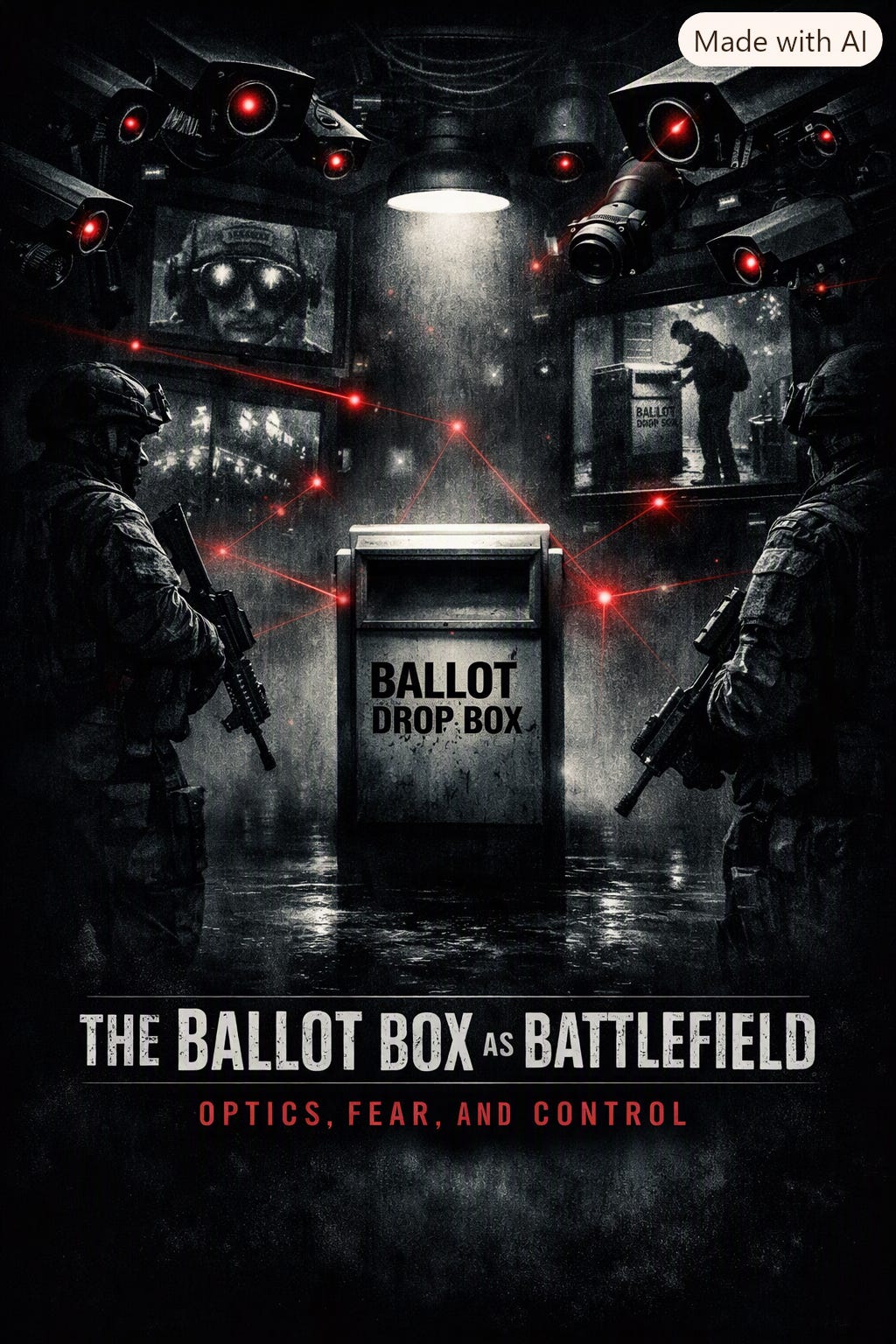
“They didn’t steal the election on Election Day. They built the walls years before anyone showed up to vote — and then called it process.”
The curtain goes up every two to four years. Cameras pan across polling lines. Anchors rehearse solemnity. Operatives on both sides manufacture urgency. The ritual is immaculate — designed to feel like democracy in motion, because it performs better that way. But the contest that determines who wins was decided long before the first voter stepped into a booth.
What the public watches on Election Night is a closing ceremony. The real competition — the one with lasting structural consequences — happens in county commission meetings, in state legislative sessions, in the offices of secretaries of state, and in the conference rooms of organizations whose names most voters have never heard. It happens in the budgeting of polling locations, the management of voter rolls, the litigation strategy of well-funded legal networks, and the editorial decisions of media conglomerates that choose what to amplify and what to let quietly die.
The ballot box is not a democratic instrument. It is contested terrain. And the forces competing for control of that terrain — legislative architects, donor networks, media gatekeepers, and procedural bureaucracies — operate with a precision and patience that the daily news cycle was never built to track. Project Playbook is built for exactly that.
I. The Architecture of Suppression
Polling place closures do not announce themselves as voter suppression. They arrive as budget decisions, efficiency reviews, and lease terminations. Between 2012 and 2022, more than 8,700 polling locations were shuttered across the United States — the bulk of those closures concentrated in counties with higher populations of Black, Latino, and low-income voters. The mechanism is administrative. The effect is structural.
Voter roll purges operate on similar logic. States maintain the authority to remove inactive or ineligible voters from their rolls — a legitimate function that, in documented practice, has been deployed to excise eligible voters at scale. Georgia’s “use it or lose it” purge process, litigated repeatedly in federal court, removed hundreds of thousands of registered voters ahead of competitive statewide elections. The purges were legal. The targeting patterns were not incidental.
Identification requirements form the third pillar. The specifics vary by state — some accept only government-issued photo ID, some reject student identification, some require documents that are disproportionately difficult for elderly, poor, or rural voters to obtain. Research published by the Government Accountability Office found that strict voter ID laws reduce turnout among Black voters at roughly twice the rate they reduce turnout among white voters. These are not side effects. They are predictable outcomes, documented in advance, enacted anyway.
The machinery that processes these decisions — state boards of elections, county clerks, legislative redistricting committees — operates largely in public view but beyond public attention. Meetings are noticed. Minutes are published. The architecture is visible to anyone willing to look. Most are not, and the system depends on that.
II. Follow the Money
The financial architecture behind election operations does not appear on ballots. It appears in 501(c)(4) disclosures, in state party coordinated expenditure filings, and in the grant portfolios of foundations whose election-adjacent work rarely surfaces in campaign finance coverage.
On the litigation front, two legal ecosystems operate in permanent opposition: organizations like the American Civil Liberties Union and the NAACP Legal Defense Fund challenge restrictive voting laws in federal court, while counterpart networks — the Public Interest Legal Foundation among them — pursue voter roll challenges and election integrity litigation in the same courts. Both sides are well-funded. The asymmetry lies in which litigation produces injunctions that hold through Election Day and which produces delays that outlast their relevance.
Dark money — funds flowing through nonprofits not required to disclose their donors — has become the preferred vehicle for election-adjacent infrastructure spending. The Brennan Center for Justice has tracked hundreds of millions of dollars in undisclosed contributions flowing into organizations that engage in voter registration, election administration advocacy, and ballot access litigation. The donors are unknown by design. The beneficiaries are traceable. The direction of the money, consistently, is toward systems that preserve existing barriers to participation rather than reduce them.
The money always tells you who benefits from the current system. In election infrastructure, the current system benefits incumbency, party establishment, and the institutional donors who fund both.
III. The Media Battlefield
Coverage of elections in the United States is voluminous and structurally narrow. Billions of dollars in earned and paid media concentrate on candidate performance, polling averages, debate moments, and fundraising totals. The procedural machinery — the rules governing who votes, how ballots are counted, and which challenges advance through the courts — receives a fraction of that attention, and what coverage it does receive is shaped by a false equivalence that has become the industry default.
“Both sides” framing serves a specific function in election reporting: it converts documented asymmetries into apparent debates. When one party enacts 28 new voting restrictions in a legislative session and another files legal challenges to 12 of them, a “both sides are fighting over voting rules” frame is technically accurate and functionally misleading. The disproportion disappears into the structure of the sentence. The mechanisms remain invisible.
Media ownership concentrates that invisibility. Sinclair Broadcast Group operates local television stations in markets covering the majority of U.S. households. iHeart Media controls more than 850 radio stations. The editorial posture of these platforms is not uniform, but their ownership structures create predictable gravitational pulls — toward content that does not threaten the regulatory relationships their parent companies depend on, and away from reporting that names institutional beneficiaries of existing election law.
Which election stories get told is an editorial decision. Which get buried is also an editorial decision. The absence of coverage is not neutral. It is a choice with consequences that compound across every election cycle in which the machinery operates without examination.
IV. What the System Protects
Pull the lens back far enough and the pattern resolves into something simpler than conspiracy. The ballot box as battlefield is not primarily about winning any single election — it is about controlling the conditions under which elections occur: who gets to compete, who gets to vote, and who gets to count.
That control transcends party. Republican-controlled legislatures have enacted the bulk of recent voting restrictions, but Democratic-controlled jurisdictions maintain their own structural barriers — primary systems that exclude independent voters, ballot access requirements that disadvantage third-party candidates, and redistricting processes that protect incumbents regardless of their party label. The system does not protect Republicans or Democrats. It protects incumbency and the institutional infrastructure built around it.
What sustains this system across administrations and across party lines is not coordination — it is institutional inertia, the accumulated weight of rules, precedents, funding structures, and relationships that reproduce themselves because the people positioned to change them benefit most from their continuation. Reform is possible. History shows it. But it has never arrived from the inside without sustained, documented, external pressure.
That pressure requires seeing the machinery clearly.
Project Playbook does not tell you what to think. There are no shortage of institutions eager to perform that service. What this series does is slower and less comfortable: it maps the mechanisms. It traces the money. It names the architecture that shapes every outcome before the outcome is announced.
The battlefield is real. The combatants are not the ones on your television screen. And the rules of engagement were written by people who understood, from the beginning, that the side that controls the terrain controls the result.
The election doesn’t begin on Election Day. It ended there — the rest was already decided.
Project Playbook© tracks how corporations, governments, and media networks shape what the public sees, using verified information to cut through the noise. Free for now — it delivers a stark, shadow-lined view of the forces behind the narrative.
ENDNOTES — PROJECT PLAYBOOK SOURCE VERIFICATION
Common Dreams. ‘Affront to Democracy’: Trump’s National Guard Troops Seen in Front of Ballot Box in DC.
https://www.commondreams.org/news/national-guard-ballot-drop-box(commondreams.org in Bing)Hoodline. National Guard Near DC Ballot Drop Box Sparks BOE Complaint.
https://hoodline.com/2026/10/national-guard-near-dc-ballot-drop-box-sparks-boe-complaint/(hoodline.com in Bing)NBC4 Washington. Image of National Guard Around DC Ballot Drop Box Causes Concern.
https://www.nbcwashington.com/news/local/national-guard-ballot-drop-box-concern-dc/4165777/(nbcwashington.com in Bing)Federal Statute: 18 U.S.C. § 592. Prohibits “any troops or armed men” at places where elections are held, except to repel armed enemies.
https://www.law.cornell.edu/uscode/text/18/592(law.cornell.edu in Bing)Bipartisan Policy Center. Research on voter anxiety and uniformed presence near voting infrastructure. https://bipartisanpolicy.org
Academic Literature on Surveillance & Civic Behavior. Studies on authority presence, security theater, and democratic erosion.
https://www.jstor.orgX (formerly Twitter). D.C. Council public statement regarding troop presence near ballot box.
https://twitter.comTikTok. Original Foggy Bottom footage documenting National Guard proximity to ballot box.
https://www.tiktok.com