


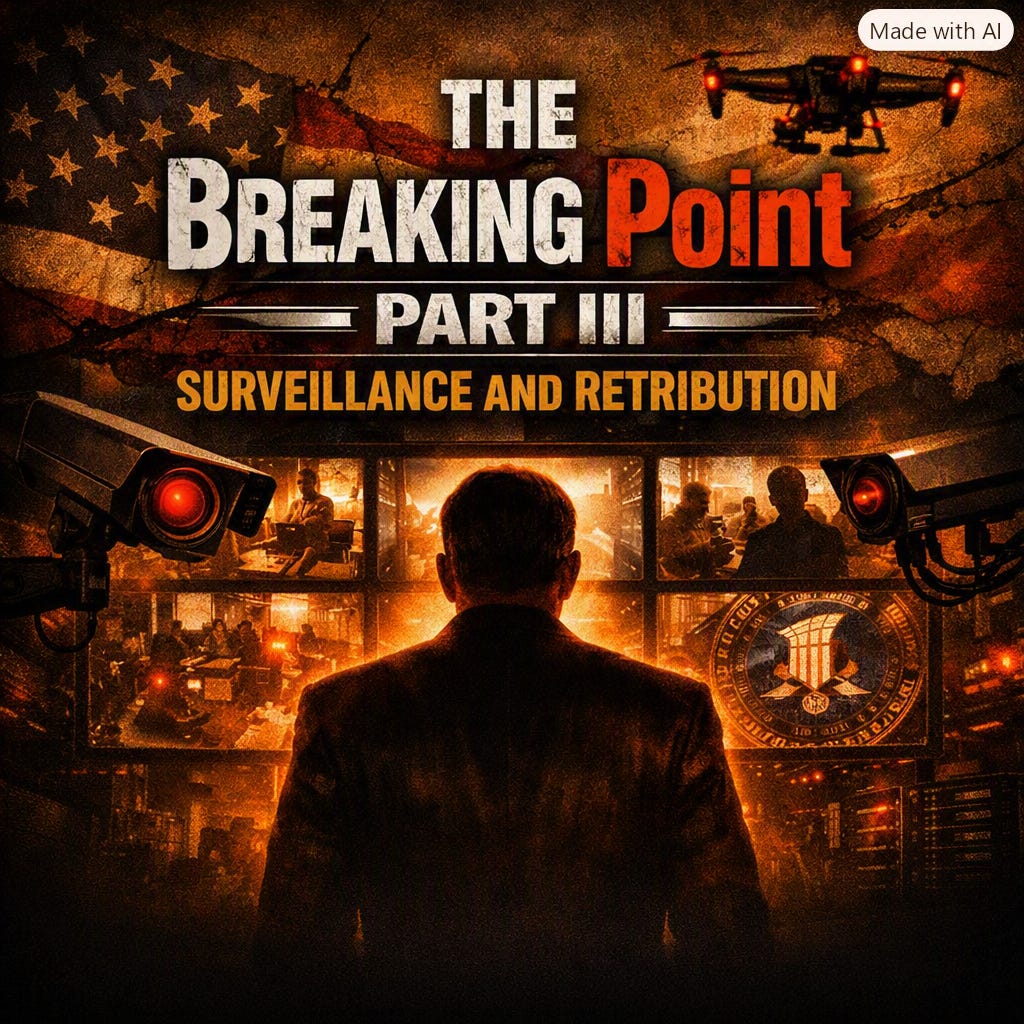
The Breaking Point - Part III: Surveillance and Retribution
When Power Stops Watching the System and Starts Watching You
Part II ended with a wobble - a moment when the machinery of a political movement no longer responded on cue. The boos in South Carolina, the donor hesitation, the fractured endorsements - all of it signaled a system losing its automatic obedience. But political machinery rarely collapses cleanly. It mutates. It adapts. And when a leader feels the ground shift beneath him, the instinct is not to steady the system. It’s to tighten the grip.
Part III begins with that tightening.
Since mid-August, the story has shifted from fracture to surveillance - not metaphorical, not rhetorical, but documented. Multiple watchdog groups and newsrooms have traced the same pattern: a movement responding to public pushback by turning inward, watching critics, and weaponizing institutions meant to protect the public.
I. The Machinery Turns Inward
The Department of Justice - once the neutral spine of federal law enforcement - has become the focal point of this pivot.
American Oversight has published new records showing how Trump-aligned officials pushed investigations targeting perceived enemies, from former national security officials to state attorneys general. Their reporting highlights the DOJ’s Weaponization Working Group, described as a clearinghouse for politically motivated inquiries and retaliatory case-building.
This isn’t the wobble of Part II. This is the machinery re-aiming itself.
And the re-aiming is deliberate. FOIA stonewalling, record concealment, and selective investigations aren’t bureaucratic friction - they’re strategy. They’re the quiet architecture of surveillance.
II. The Target List Grows
While watchdog groups track the institutional side, ABC News has continued documenting the personal side - the expanding list of individuals Trump has publicly threatened with prosecution or investigation. Since your last post, that list has grown to include former intelligence officials, state prosecutors, and even internal critics who once served in senior roles.
Some have faced attempts to strip their security clearances. Some have faced pressure campaigns to open investigations. Some have simply been named - and naming is often enough.
This is bullying elevated to governance: critics don’t just get attacked. They get investigated.
The chilling effect is not theoretical. Officials have told reporters they fear retaliation for speaking publicly. Whistleblowers describe pressure not to document misconduct. The machinery is no longer wobbling - it’s watching.
III. The Blanche Confirmation: Consolidation, Not Appointment
The confirmation of Todd Blanche as Attorney General marks the moment surveillance becomes systemic.
Protect Democracy’s Authoritarian Action Watch describes Blanche’s confirmation as consolidating Trump’s control over federal law enforcement - a structural shift, not a personnel change. Their escalation tracker rates the tactic of politicizing independent institutions as rapidly increasing, citing Blanche’s role in advancing politically charged investigations.
This is the hinge of Part III: when surveillance stops being reactive and becomes policy.
The DOJ is no longer merely responding to political pressure. It is being shaped to apply it.
IV. The Chilling Effect: When the System Watches You
Surveillance is not a show of strength. It’s a confession of fear.
It’s what happens when a leader stops trusting the machinery and starts distrusting the people inside it. When dissent becomes a threat. When criticism becomes a case file. When political opposition becomes something to be monitored rather than debated.
The consequences ripple outward:
· Whistleblowers hesitate.
· Officials self-censor.
· Agencies slow their oversight.
· Critics weigh the cost of speaking.
This is how a political movement transitions from influence to enforcement - not through dramatic purges, but through quiet pressure, targeted investigations, and the knowledge that someone is watching.
Part III is the chapter where the stakes change. Part II was about fracture. Part III is about retaliation.
And retaliation is the beginning of retribution.
V. What Comes Next
Part IV will follow the consequences - not for Trump, but for the ecosystem around him: the agencies, the watchdogs, the courts, the states, and the individuals who must decide whether to comply, resist, or disappear from view.
Surveillance is the hinge. Fallout is the door that swings open next.
Zuboff, S. (2019). The Age of Surveillance Capitalism. PublicAffairs.
Lyon, D. (2015). Surveillance After Snowden. Polity Press.
Andrejevic, M. (2007). iSpy: Surveillance and Power in the Interactive Era. University Press of Kansas.
Richards, N. M., & King, J. H. (2013). Three paradoxes of big data. Stanford Law Review, 66(1), 41–46.
Pasquale, F. (2015). The Black Box Society. Harvard University Press.
Brayne, S. (2020). Predict and Surveil: Data, Discretion, and the Future of Policing. Oxford University Press.
Ferguson, A. G. (2017). The Rise of Big Data Policing. NYU Press.
Solove, D. J. (2007). The Digital Person: Technology and Privacy in the Information Age. NYU Press.