


Every system has a moment when its fear becomes visible. Not in speeches or policies, but in the cracks — the rusting hull, the moral misfire, the procedural grab for control. Part IV isn’t about escalation. It’s about consequence. It’s the moment when the system stops reacting to threats and starts reacting to itself.
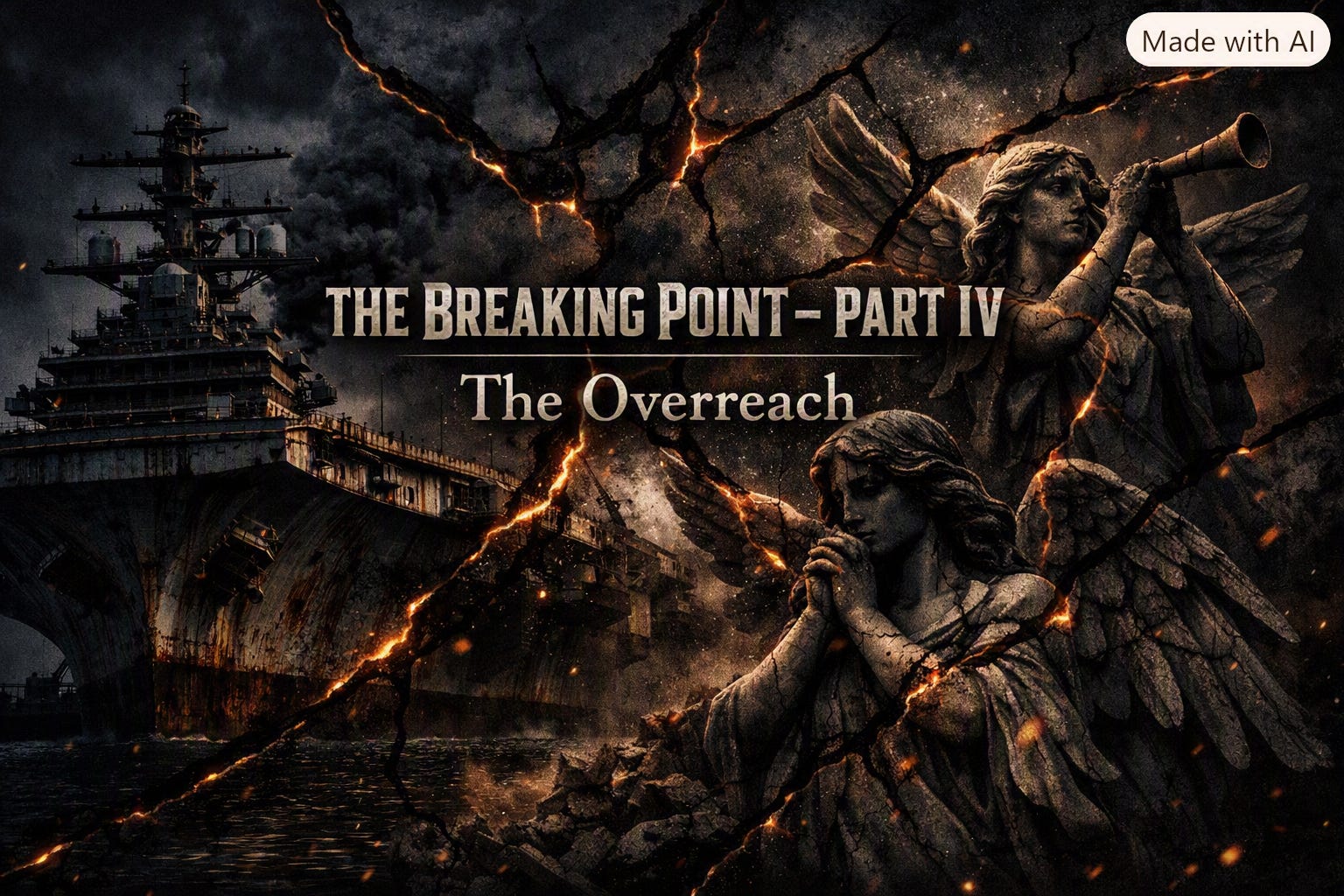
The signs never arrive in a single headline. They arrive as fragments — a rust‑stained carrier, a politician assigning himself a probability of entering heaven, a petition asking the Supreme Court to rewrite how millions of people vote. None of these stories are connected on the surface. But together, they form the unmistakable silhouette of a system under strain.
When a nuclear aircraft carrier shows visible corrosion, it’s not just a maintenance failure. It’s a metaphor for institutional fatigue — a physical reminder that even the strongest structures degrade when priorities shift from stability to survival. Rust is slow, quiet, and patient. It spreads when no one is looking. It spreads faster when everyone is looking somewhere else.
A rusting hull is never just a hull. It’s a symptom of misallocated attention. It’s what happens when a system becomes so focused on external threats that it neglects its own foundations. Fear doesn’t strengthen institutions. It hollows them out.
When a political figure quantifies salvation, the backlash isn’t about theology. It’s about legitimacy. It’s about the moment when moral authority becomes performative — when the system tries to define something it cannot control. The public reaction isn’t outrage; it’s recognition. People can sense when a system is improvising its own righteousness.
A “heaven probability” isn’t a religious statement. It’s a calibration error — a sign that the system is trying to measure the immeasurable, to assign metrics to meaning. It’s what happens when fear of moral irrelevance pushes institutions into territory they cannot govern. The backlash is simply the public noticing the overreach.
And when a leader asks the Supreme Court to approve sweeping changes to mail‑in ballots, the tension isn’t procedural. It’s existential. It’s the system attempting to rewrite the rules of its own continuity. It’s the moment when fear becomes policy — when the process itself becomes a battleground.
Procedural overreach is the clearest sign of institutional fear. Systems rewrite rules when they no longer trust outcomes. They tighten controls when they no longer trust people. They escalate oversight when they no longer trust themselves.
These aren’t isolated events. They’re symptoms. They’re the tremors that come after the break, not before it. Part IV is where the series stops tracking escalation and starts tracking consequence. It’s where the system’s fear becomes visible enough to measure — not in statements, but in structural failures, moral misfires, and procedural overreach.
Fear is corrosive. It rusts metal. It distorts morality. It warps procedure. It makes systems act against their own stability. It makes institutions mistake control for strength. It makes leaders mistake improvisation for authority.
This is the final movement of The Breaking Point:
The system doesn’t collapse when it's
challenged.
It collapses because it became afraid.
REFERENCES:
Lendon, B. (2026, September 4). Rusty state of USS Abraham Lincoln after marathon deployment shocks observers. CNN via The Portland Medium.
Garnett, S. (2026, September 3). Rusty USS Lincoln docks in Thailand. CNN.
Shrivastav, A. (2026, September 4). USS Abraham Lincoln’s rust‑covered arrival in Thailand reveals toll of 286‑day combat deployment. Free Press Journal.
Gioia, M. (2026). JD Vance trolled after he rates his chances of getting into Heaven: “This is rather shocking.” NewsBreak.
Howe, A. (2026, September 6). Trump administration again appeals mail‑in ballot dispute to the Supreme Court. SCOTUSblog.
CNBC Staff. (2026, September 6). Trump administration makes another appeal to the Supreme Court to allow mail‑in ballot restrictions. CNBC.
Fritze, J., & Sneed, T. (2026, July 27). Trump asks Supreme Court to let him curtail mail voting. CNN via KRDO.
Howe, A. (2026, September 3). Trump administration asks Supreme Court to clear the way for it to implement new mail‑in voting rule. SCOTUSblog.
Howe, A. (2026, September 6). Trump administration again appeals mail‑in ballot dispute to the Supreme Court. SCOTUSblog (expanded filing).