

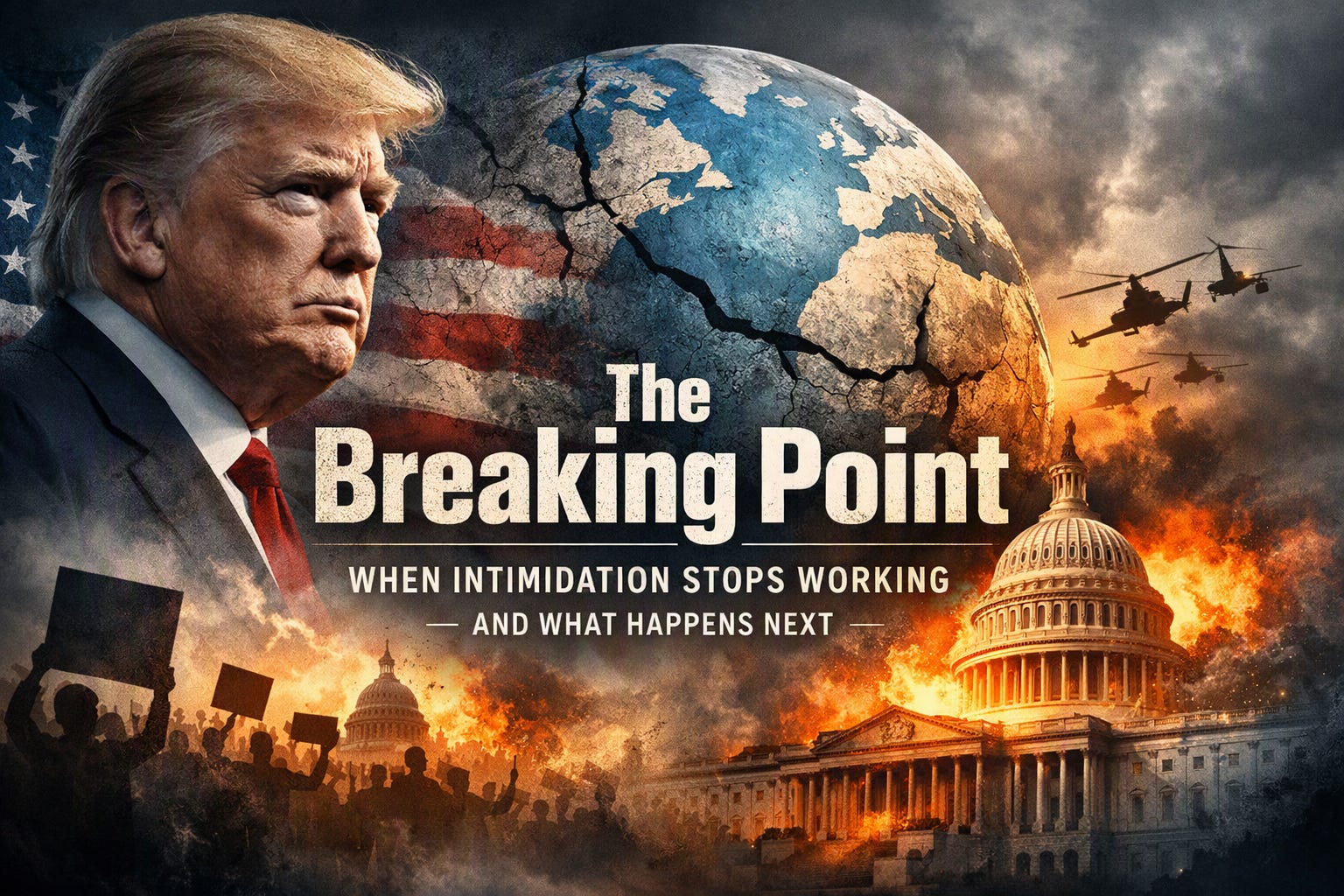
The Moment the Machinery Stops
Something fundamental has shifted in American political gravity. The intimidation tactics that once powered Donald Trump’s political momentum — the threats, the public shaming, the performative dominance — are no longer producing compliance. They are producing backlash.
The Washington Post’s August 24, 2026 analysis makes this clear: Trump’s coercive style is failing both domestically and internationally. But the deeper story — the one I began in “This Is Outrageous” — is about what happens after intimidation stops working.
What does a leader do when fear no longer moves people, when allies no longer flinch, when the public no longer buys the pitch?
History tells us the answer: They escalate. And escalation from a weakened leader is the most dangerous political phase of all.
I. The Collapse of the Bully’s Leverage
The Washington Post reports Trump’s approval rating at 36%, with 63% disapproval. Globally, the numbers are even more severe: 76% of respondents across 36 countries have no confidence in Trump, and 57% hold an unfavorable view of the United States under his leadership. In several countries, China is viewed more favorably than the U.S.
This is not normal political erosion. This is a leader losing the ability to intimidate.
In “This Is Outrageous,” I argued that Americans have grown numb to democratic backsliding — conditioned to accept “outrageous” behavior as background noise. Now, the Post’s reporting shows the consequences of that numbness: a leader who escalates because persuasion is no longer available to him.
II. Threats Without Traction
The Post outlines a series of threats that would have been unthinkable under any previous administration:
● Threatening military action to annex Greenland, prompting European defensive mobilization
● Threatening tariffs on Canada over wildfire smoke — followed by actual 50% tariffs
● Threatening to “bomb the shit” out of Oman, an ally, during Iran negotiations
● Reducing joint military exercises with South Korea, citing personal rapport with Kim Jong Un
● Threatening to withdraw U.S. troops from Spain and Italy if they didn’t support his Iran policy
These are not diplomatic maneuvers. They are pressure tactics — and they are failing.
In “This Is Outrageous,” I framed this pattern as part of a broader authoritarian drift: a leader who substitutes intimidation for governance, spectacle for strategy, and crisis for competence. The Post confirms the same pattern from a different angle: the intimidation is no longer effective, but the behavior continues anyway.
III. When Intimidation Fails, Escalation Begins
This is where additional reporting becomes essential.
A. Right-Wing Figures Turning on Trump
Recent coverage shows Trump publicly attacking Tucker Carlson, Thomas Massie, and Marjorie Taylor Greene — calling them “LOSERS.” These once-loyal MAGA figures fired back, calling Trump “no different than an internet troll” and warning that his rhetoric is “unbecoming of the office.”
This is not left-wing criticism. This is internal fracture — a sign that intimidation is losing its potency even among his base.
B. The Natalie Harp Scandal Backfires
Reporting on the Natalie Harp scandal shows Trump’s anger causing aides to lash out more aggressively — which only drew more leaks, more scrutiny, and more internal dissent. Advisers reportedly believe Harp’s influence is “poisonous” and responsible for some of Trump’s ugliest social-media posts.
This is intimidation failing inside the building.
Together, these sources show a leader whose coercive style is no longer producing loyalty — only chaos.
IV. The Public’s Role in the Backfire
The Post notes that Trump’s messaging has lost its marketing finesse — the “Make America Great Again” simplicity replaced by scattershot threats and reactive posture. In “This Is Outrageous,” I argued that the public has become dangerously tolerant of political spectacle, failing to recognize how quickly democratic norms can erode.
Put together, the message is clear:
● The public is less persuaded
● The world is less intimidated
● The administration is more erratic
● The stakes are rising
This is the moment when democracies either wake up or slide further.
V. The Combined Thesis
Here is the unified argument — the one that merges all sources into a single, sharpened editorial:
Trump’s bullying has stopped working. But instead of recalibrating, he is escalating. And escalation from a weakened leader is the most dangerous political phase of all.
This is not about ideology. It is not about party. It is about behavior, patterns, and risk.
“This Is Outrageous” warned that Americans have been lulled into complacency. The Washington Post shows what complacency enables. The right-wing backlash shows the erosion of internal support. The Harp scandal shows the dysfunction inside the operation.
The bully’s power is fading. The bully’s tactics are intensifying. And the country is entering the part of the story where institutions either hold — or crack.
Footnotes:
1. Washington Post analysis on Trump’s intimidation tactics failing internationally and domestically (Aug. 24, 2026).
2. Yahoo News UK reporting on Trump attacking Tucker Carlson, Thomas Massie, and Marjorie Taylor Greene, and their public rebuke.
The New Republic reporting on the Natalie Harp scandal and internal dysfunction within Trump’s circle.